Bringing History Home: Ambassadors Aminu Alhaji Iyawa and Yakubu Audu Dadu in Nigeria's Recovery of an Ife Artefact from Mexico
The Diplomatic Roles of Aminu Alhaji Iyawa and Yakubu Audu Dadu in Nigeria’s Quest to Reclaim Its Cultural Heritage
By Fyneface Amadi
In February 1897, British forces invaded Benin City, destroyed the royal palace and carried away thousands of objects representing centuries of the kingdom's history. Bronze plaques, commemorative heads, ivory carvings, royal regalia and other cultural objects were subsequently sold to collectors and museums across Europe and beyond. Many remain in foreign institutions and private collections more than a century later.
The looting of Benin was among the most extensively documented episodes in the dispersal of Nigeria's cultural heritage. Elsewhere, objects associated with the ancient civilisations of Ile-Ife, Nok and other Nigerian societies found their way abroad through commercial dealings, illicit excavation, smuggling and unauthorised export. In many instances, their removal separated them from the historical settings and communities that provided the context for understanding them.
For decades, Nigeria has pursued the restitution of these objects through diplomatic negotiations, legal processes, international conventions and the activities of the National Commission for Museums and Monuments. The campaign has achieved some notable successes, particularly in recent years.
In 2020, the Netherlands returned a terracotta head associated with the ancient Ife civilisation after Dutch customs authorities intercepted it. In October 2022, the Smithsonian Institution in the United States transferred ownership of 29 Benin objects to Nigeria, although some remained in Washington under loan arrangements. The Horniman Museum in London also transferred ownership of 72 objects taken during the 1897 invasion, with six physically returned that year.
Germany has similarly undertaken the restitution of substantial collections of Benin objects. In June 2025, the Netherlands completed the return of another 119 Benin objects, in what its government described as the largest physical return of Benin artefacts to Nigeria up to that time.
These developments demonstrate the possibilities of sustained engagement, but they also reveal the complexities of restitution. Many Nigerian cultural objects remain abroad. Some museums face legal restrictions on transferring their collections, while others contest the circumstances under which objects were acquired. Incomplete provenance records, negotiations over ownership, conservation requirements and questions about custody after restitution can prolong the process for years.
Even successful transfers sometimes leave the objects physically outside Nigeria under loan agreements. The recovery of legal ownership and the return of an object to its place of origin are not always the same thing.
It is within this long history of dispossession and recovery that the roles of two Nigerian diplomats, Ambassadors Aminu Alhaji Iyawa and Yakubu Audu Dadu, deserve attention.
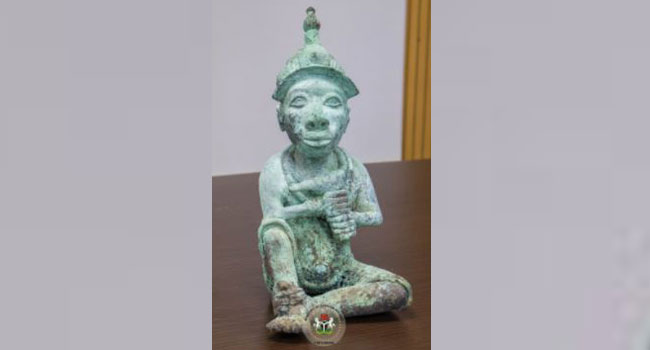
Their involvement concerned a bronze sculpture attributed to the ancient Yoruba civilisation of Ile-Ife, intercepted at Mexico City International Airport and subsequently returned to Nigerian custody.
Ile-Ife occupies a central place in Yoruba historical traditions as a centre of origins, sacred kingship and political authority. Its naturalistic copper-alloy and terracotta sculptures, particularly those associated with the twelfth to fifteenth centuries, provide evidence of sophisticated artistic and technological traditions. Consequently, objects identified with Ife heritage possess historical significance extending beyond their material or commercial value.
The Mexican recovery began in 2017, when Aminu Alhaji Iyawa, Nigeria's ambassador to Mexico, became aware of a sculpture suspected to be of Nigerian origin at Benito Juárez International Airport in Mexico City. His suspicions prompted enquiries and engagement with Mexican authorities.
The process involved officials of Mexico's customs administration, the Ministry of Foreign Affairs, the Ministry of Culture and the National Institute of Anthropology and History. The Nigerian Embassy maintained diplomatic contact as investigations and restitution arrangements proceeded.
Yakubu Audu Dadu joined the mission in October 2018 as minister responsible for administrative, political and economic affairs. His arrival strengthened the mission's diplomatic personnel during the ongoing recovery process.
The embassy sustained its engagement with the Mexican authorities and, on 25 February 2020, the Mexican government finally handed over the sculpture to Nigeria's diplomatic representatives at a ceremony attended by Mexico's Undersecretary of Foreign Affairs, Julián Ventura.
The Mexican government described the transfer as an expression of its commitment to combating illicit trafficking in cultural property and acknowledged the cooperation between the two countries.
Although this completed the formal handover in Mexico, another stage remained: bringing the object to Nigeria and transferring it to the appropriate authorities.
By October 2020, Dadu had assumed leadership of the Nigerian Embassy as chargé d'affaires ad interim. He continued the mission's work on the artefact's return, overseeing its subsequent diplomatic handling and presentation to the Nigerian government.
On 8 April 2021, Dadu formally presented the sculpture to Nigeria's Minister of Foreign Affairs, Geoffrey Onyeama, in Abuja. Onyeama acknowledged Iyawa's role in drawing attention to the object and thanked the Mexican authorities for facilitating its recovery, and Dadu for seeing it through.
The occasion marked the culmination of a process spanning several years and successive diplomatic appointments. It also illustrated an important principle of public service: major institutional achievements often result from continuity rather than individual action. Iyawa's intervention and diplomatic engagement laid the foundation for the return, while Dadu's subsequent responsibilities ensured the process was carried through to its final presentation in Nigeria.
Nevertheless, the recovery has an important historical qualification. Although Nigerian and Mexican authorities described the sculpture as an ancient Ife artefact, its authenticity was questioned by some specialists in African art. The original Mexican curatorial assessment also recommended further expert examination and scientific testing.
The object, sometimes described in reports as a bronze head, is actually a seated figure. Its precise antiquity and provenance have not been conclusively established in the publicly available documentation.
This controversy is relevant because the credibility of historical preservation depends on evidence. Diplomatic restitution and archaeological authentication are distinct responsibilities, and successfully transferring an object does not automatically establish its age or origins.
The cooperation between Nigeria and Mexico remains a significant example of international heritage diplomacy. It shows that protecting cultural property requires the participation of customs authorities, cultural institutions, researchers, and diplomatic representatives, sometimes over several years.
It also reminds us that preserving Nigeria's history is not solely the responsibility of historians, archaeologists, or museum professionals. Diplomats can contribute by identifying cultural-property concerns, facilitating investigations, maintaining international communication and securing the cooperation necessary for restitution.
The contributions of Aminu Alhaji Iyawa and Yakubu Audu Dadu deserve to be remembered within this broader history of Nigeria's efforts to recover its dispersed cultural heritage.
The Diplomats Behind the Recovery
Ambassador Aminu Alhaji Iyawa
Aminu Alhaji Iyawa is a Nigerian journalist, public administrator and diplomat who served as Nigeria's Ambassador Extraordinary and Plenipotentiary to Mexico, with concurrent accreditation to Costa Rica, Guatemala and Panama.
Iyawa is from Adamawa State. He began his professional career in broadcast journalism in 1979 with the Nigerian Television Authority, then worked as a senior news editor and held public relations responsibilities in government institutions.
He studied in Los Angeles, United States, from 1980 to 1985, and his education includes Columbia College Hollywood, public relations training in London, and postgraduate journalism studies at Robert Gordon University, Aberdeen, Scotland.
His career included appointments as chief press secretary and media adviser to governors of Adamawa State. He also served in the state's executive council, including as Commissioner for Rural Infrastructure between 2012 and 2014.
Iyawa was associated with Daily Trust, serving on its editorial board, and entered partisan politics in 2008. He joined the All Progressives Congress following its emergence and was subsequently appointed ambassador under President Muhammadu Buhari.
He arrived in Mexico on 22 August 2017 and presented his letters of credence on 24 August. Mexico was his first ambassadorial posting. His diplomatic responsibilities included promoting bilateral trade, investment, tourism, cultural exchanges and consular cooperation between Nigeria and the countries of his accreditation.
During his tenure in Mexico, he became involved in recovering the sculpture attributed to Ile-Ife after it was identified at Mexico City International Airport in 2017. He represented Nigeria at the formal restitution ceremony held by the Mexican government on 25 February 2020.
Ambassador Yakubu Audu Dadu
Yakubu Audu Dadu is a Nigerian career diplomat.
Born in Plateau State, he attended LGED Primary School, Bachi, and Government Teachers' College, Gindiri, before obtaining a National Certificate in Education from the College of Education, Akwanga, in 1991. He graduated in Political Science from the University of Abuja in 1997, obtained a master's degree in International Relations and Strategic Studies from the University of Jos in 2004 and earned a doctorate in International Relations and Diplomacy in Paris in 2014.
Dadu began his public service career at the Public Complaints Commission during his National Youth Service in 1998 and joined Nigeria's Ministry of Foreign Affairs in 2001.
His early assignments included responsibilities for Eastern Europe, Western Europe and Commonwealth affairs. Between 2006 and 2009, he served at the Nigerian Embassy in Paris, handling consular, immigration and political matters.
From 2012 to 2014, he served at Nigeria's Permanent Mission to the United Nations in New York, working on the General Assembly's Fifth Committee and Security Council affairs. He subsequently held positions in the ministry's United Nations Division and the Directorate of Technical Aid Corps.
In October 2018, Dadu was posted to the Nigerian Embassy in Mexico City as minister responsible for administrative, political and economic affairs. He became chargé d'affaires ad interim in October 2020 and served in that capacity until June 2021. During this appointment, he completed the final diplomatic stage of the Ife sculpture's return, presenting it to Nigeria's Minister of Foreign Affairs in Abuja on 8 April 2021.
His research interests include international security and regional cooperation against the illicit proliferation of small arms and light weapons, particularly within the ECOWAS region. He contributed to Anatomy of a Consensus, edited by former Nigerian diplomat Joy Ogwu, on implementing international small-arms control commitments.
Culled from Missions Roundup. May–July 2021.