Charter of the Order of Service and Legacy (OSL)
The Order of Service and Legacy (OSL) is an honour established by the Institute for Historical Studies, Biographical Research, Documentation and Legacy (IHS-BiRD & L) to recognise individuals and organisations whose service, leadership, and sustained contributions advance society and nation-building in Nigeria and beyond, reflecting verifiable impact, integrity, and enduring legacy across public, enterprise, knowledge, and humanitarian spheres.
Preamble
The Institute for Historical Studies, Biographical Research, Documentation and Legacy (IHS-BiRD & L) establishes the Order of Service and Legacy (OSL) to honour Nigerians and friends of Nigeria—both individuals and institutions—whose lives, leadership, and collective endeavours exemplify outstanding service, visionary leadership, and enduring contributions to society.
The Order recognises those whose actions strengthen institutions, drive economic advancement, expand knowledge, uplift communities, uphold justice, and advance the values that shape a stronger, united, and prosperous society.
For the purpose of this Order, “Service” is understood in its broadest sense to include contributions through:
(i.) Public administration and governance
(ii.) Enterprise and economic development
(iii.) Knowledge, research, and education
(iv.) Civic, humanitarian, and community advancement
The Order affirms that all meaningful contributions to societal progress—whether rendered by individuals or through institutions—constitute service and are worthy of recognition and preservation as legacy.
Structure of the Order
The Order of Service and Legacy is a single unified honour comprising Divisions of Service, through which contributions across different sectors of society are recognised.
The Order shall be conferred upon:
(a.) Individuals, recognised as Laureates of Service
(b.) Institutions, recognised as Legacy Institutions of Service
Both categories are equal in prestige and unified under the philosophy of Service and Legacy.
Divisions of the Order
(a.) Public Service Division: Recognises contributions in governance, public administration, and institutional leadership.
(b.) Enterprise and Economic Service Division: Recognises contributions in business, entrepreneurship, industry, innovation, and job creation.
(c.) Knowledge and Academic Service Division: Recognises contributions in education, research, scholarship, historical preservation, and intellectual advancement.
(d.) Civic and Humanitarian Service Division: Recognises contributions in community development, philanthropy, social impact, and humanitarian service.
All divisions shall apply equally to individuals and institutions, and all divisions remain equal in prestige.
Classes of the Order and Post-Nominals (Individuals)
The following classes apply to individual recipients across all divisions of the Order:

1. Notable Legacy Laureate of Public Service (NLLPS)
Eligibility: Individuals whose service has had a remarkable impact at the community or local government level.
Purpose: Recognises dedication and promise in improving lives and advancing grassroots development.

2. Meritorious Legacy Laureate of Public Service (MLLPS)
Eligibility: Individuals whose contributions demonstrate sustained service and significant impact at the state level or within a professional field.
Purpose: Celebrates consistent service and achievement that enhance leadership and institutional growth.

3. Distinguished Legacy Laureate of Public Service (DLLPS)
Eligibility: Individuals whose work has achieved regional, national, or professional distinction.
Purpose: Honours exemplary service, leadership, and influence that contribute to national progress.

4. Grand Legacy Laureate of Public Service (GLLPS)
Eligibility: Exceptional individuals whose achievements have monumental national or global significance.
Purpose: Recognises the pinnacle of service and establishes an enduring historical benchmark.
Classes of the Order (Institutions)
The following classes apply to institutional recipients of the Order:
1. Notable Legacy Institution of Public Service (NLIPS): Recognises institutions with significant and promising impact at the community or local level.
2. Meritorious Legacy Institution of Public Service (MLIPS): Recognises institutions with sustained contributions and measurable impact at the state or sectoral level.
3. Distinguished Legacy Institution of Public Service (DLIPS): Recognises institutions of regional or national distinction demonstrating excellence, leadership, and influence.
4. Grand Legacy Institution of Public Service (GLIPS): Recognises institutions of exceptional national or global significance whose legacy establishes enduring benchmarks.
Eligibility and Definition of Institutional Service
Eligible institutions include, but are not limited to:
(a.) Corporate organisations and business enterprises
(b.) Academic, research, and educational institutions
(c.) Non-profit organisations, foundations, and civil society bodies
(d.) Public institutions, agencies, and governmental bodies
(e.) Cultural, heritage, and knowledge-preserving institutions
For the purpose of this Order, Institutional Service is defined as structured, sustained, and measurable contributions delivered through organisational leadership, governance systems, operations, and societal engagement, resulting in demonstrable advancement of communities, sectors, or national development.
Principles of the Order
(1.) Service to Society: Each award highlights contributions that uplift communities and strengthen societal and national development.
(2.) Integrity and Merit: Recipients are selected solely on the basis of verifiable service, leadership, governance, and measurable impact.
(3.) Enduring Legacy: The Order recognises achievements with lasting relevance and value to present and future generations.
(4.) Unity and Cohesion: The Order maintains a consistent and prestigious identity across all classes, divisions, and recipient categories.
(5.) Inclusivity of Contribution: Service rendered through public, private, intellectual, humanitarian, or institutional means holds equal value in nation-building.
Post-Nominals (Individuals)
(1.) NLLPS – Notable Legacy Laureate of Public Service
(2.) MLLPS – Meritorious Legacy Laureate of Public Service
(3.) DLLPS – Distinguished Legacy Laureate of Public Service
(4.) GLLPS – Grand Legacy Laureate of Public Service
Where necessary for formal citation, the Division of Service may be indicated descriptively, but post-nominals remain uniform to preserve unity of the Order.
Institutional recipients shall not use post-nominals but shall bear their full class designation in formal reference.
Insignia of the Order
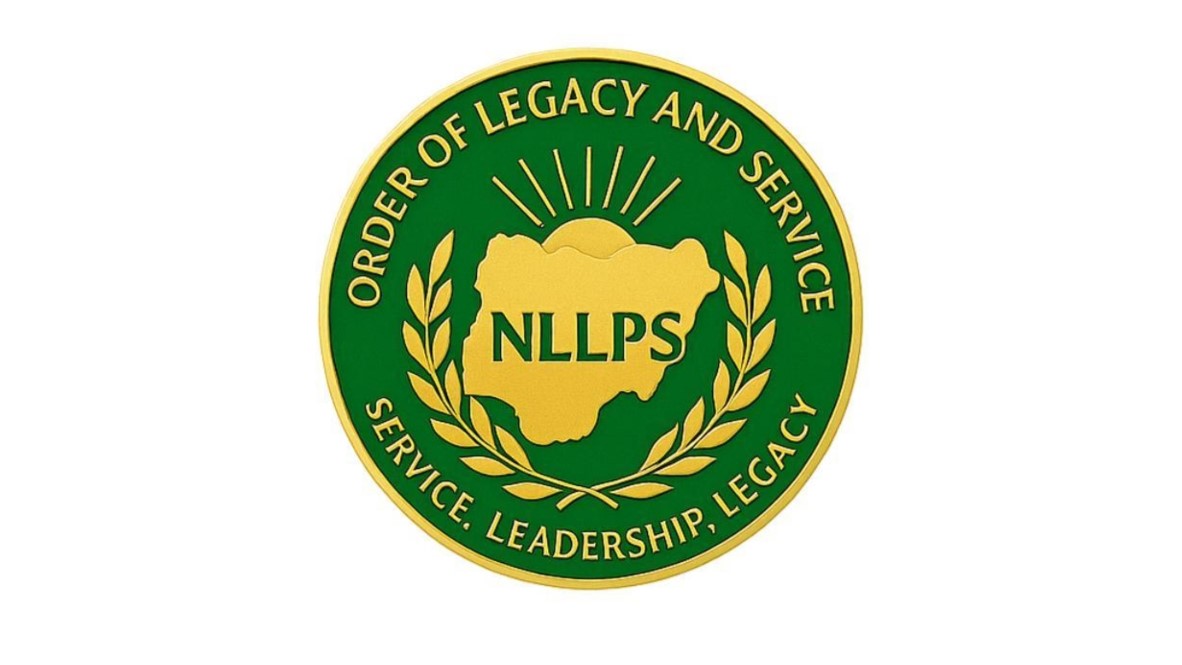
The official insignia of the Order shall be a medal or lapel pin representing service, leadership, and legacy.
Design
(a.) Circular in shape, slightly convex, with a matte finish according to class.
(b.) At its centre, the map of Nigeria merges into a rising sun, symbolising knowledge, hope, and enduring legacy.
(c.) Encircled by a laurel wreath border, signifying honour and achievement.
(d.) Around the rim appear the inscriptions:
- Above: “Order of Service and Legacy”
- Below: “Service, Leadership, Legacy”
(e.) On the Nigerian map, the class designation shall appear:
NLLPS / MLLPS / DLLPS / GLLPS (for individuals)
NLIPS / MLIPS / DLIPS / GLIPS (for institutions)
Mode of Wearing and Display
(a.) Individual recipients shall wear the insignia on the left lapel or equivalent position on traditional attire.
(b.) Institutional recipients shall display the insignia at their principal place of business or recognised premises.
(c.) The insignia serves as a visible mark of recognition and affiliation with the Order.
Presentation
(a.) Each conferment shall be accompanied by an official plaque bearing the IHS-BiRD & L logo.
(b.) The plaque shall include a QR code linking to:
(i.) The recipient’s biography or institutional profile on NDNB or affiliated platforms
(ii.) The official Justification for Conferral
(c.) Institutional recipients may reference the honour in official communications, provided such usage does not imply endorsement or commercial certification by the Institute.
Documentation and Archival Record
Each conferment shall be supported by a formally documented Justification for Conferral, detailing the recipient’s contributions, impact, and legacy.
Such documentation shall be preserved and made accessible through the Institute’s archival and publication platforms to advance scholarship, civic awareness, and national memory.
Integrity Clause
No individual or institution shall be conferred the Order where their record, conduct, governance, or operations materially contradict the principles of integrity, accountability, public trust, and societal advancement upheld by the Institute.
The Institute reserves the right to review, withhold, or withdraw recognition where credible evidence establishes inconsistency with these principles.
Ceremonial Notes
(i.) Awards may be conferred annually or at special events.
(ii.) The Order remains non-political and independent, recognising service, leadership, and societal impact rather than affiliation, position, or status.
Unity of the Order
The Order affirms that both individuals and institutions are essential to advancing society and preserving history.
Individuals embody vision and leadership; institutions sustain, expand, and transmit that legacy across generations.
The Order recognises both as complementary pillars of national memory, service, and enduring progress.
Updated: 6th day of May 2026
More Orders

Benue State Coordinator, Office of the First Lady, Scholastica Ben-Sor, Named Distinguished Legacy Laureate of Public Service
Jun 24, 2026
Arc Sonny Echono Selected for IHS-BiRD & L’s Highest Institutional Distinction
May 12, 2026

National Librarian Prof. Chinwe Veronica Anunobi Named for GLLPS Conferment by IHS-BiRD & L
May 11, 2026